Mid-Continent Railway MuseumPosted on by Jeffrey Lentz
Mid-Continent’s Restoration Department has released its 2023 work session schedule. These work sessions are a great way to get involved at Mid-Continent Railway Museum.
Our doors are open to anyone willing to give us a hand and help us with the restoration work. Give us a hand for a day or several days throughout the summer. Every bit of help makes a difference and is appreciated. We have a wide range of needs (i.e. painting, cleaning, stripping, wood work, roofing, refinishing, upholstery, metal work, and more) and everyone can be a help.
If you’re interested in volunteering please reach out! To be placed in contact with Bill Buhrmaster, MCRM’s Restoration Manager, send call the museum office at 608-522-4261.
Session No.
Dates
1
February 24-25-26-27
2
March 9-10-11
3
March 24-25-26
Extra
NEWLY ADDED DATES!!! April 4-5-6
4
April 14-15-16 REVISED DATES!!! April 21-22-23
5
April 28-29-30
6
May 10-11-12 REVISED DATES!!! May 5-6-7 May 6th is the museum-wide SPRING FLING volunteering day
7
May 26-27-28 Volunteer Open House May 27th
Extra
NEWLY ADDED DATE!!! June 6th
8
June 10-11-12 REVISED DATES!!! June 9th and 10th
Extra
NEWLY ADDED DATE!!! June 17th
9
June 21-22-23-24-25
10
July 7-8-9
11
July 22-23-24
12
August 4-5-6
13
August 25-26-27
14
September 8-9-10
15
Sept 29-30, Oct 1-2 Vintage Rail Car Tours Sept 30-Oct 1
Mid-Continent Railway MuseumPosted on by Jeffrey Lentz
Introduction
Good progress continued to be made on the DULUTH project in 2022 thanks to a crew of volunteers, hired help, contractors (for stripping, stained glass, brass polishing and woodworking) and many donors. A total of $29,650 in donations was received this past year, with the largest amount coming from the Emery Rail Heritage Trust grant ($15,000).
Stripping off the old varnish and paint finishes on the interior woodwork and vestibules was completed this year, while demolition and removal work continued. In addition to the work on the car, a big push was made this year to purchase and line up materials and restoring parts needed for completing the car. We are now starting to see new parts and pieces going back onto the car.
The main emphasis inside the car continues to be working on restoring the 10-section sleeping compartment that is the middle of the car. In this portion of the car new wiring has begun to be installed for both the berth lights as well as the annunciator system. In addition, new headlining panels were made and several of them were installed in the sleeping compartment.
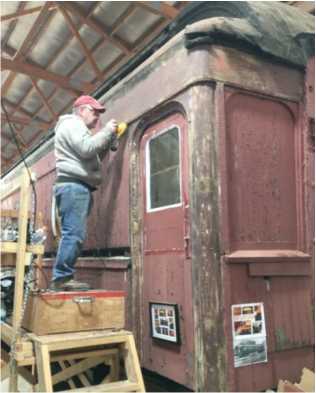
On the exterior of the car much of the old siding has been removed and we have installed a small section of new siding. In addition, removal of the old roofing is complete while the clerestory side framing removal continues. The upper and lower roof boards are in very good condition, only needing a few localized repairs.
Work on the DULUTH will resume in 2023 with a concentration in the sleeping compartment.
Photos and additional information on the progress made during 2022 on the DULUTH Project follows.
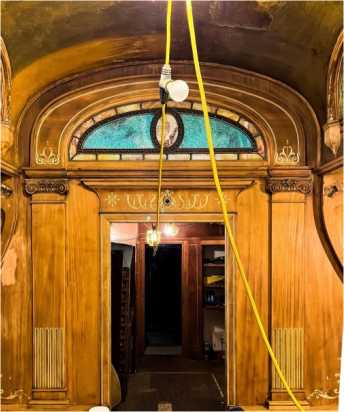
View of the sleeping compartment showing the results from stripping down the woodwork.
View in the sleeping compartment showing one of the headliner panels being painted in the original green color.
Planning
Updated 3-year restoration plan
Updated the list of the sleeping compartment work tasks and sequence of activities
Obtained proposals for reproducing additional wood parts for the car
Developing and submitting grant requests for 2023
Design Work
Measured and designed the (4) vestibule doors and end windows
Acquired samples of the curved upper drip rails (the end drops)
Measured and finalized the design for the (3) missing interior doors
Designed the upper and lower roof drip edge moldings
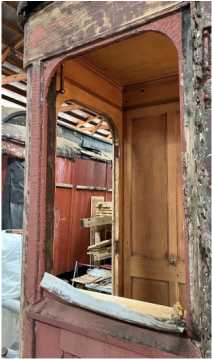
View of the vestibule end window opening that was uncovered so new window frames can be built and reinstalled.
One of many drawings made during the year. This drawing was developed for reproducing the upper roof drip rail.
Disassembly Work
Removed the balance of the old roofing material from the roof
Removed the clerestory wall coverings and roofing on the east side
Removed the original lower car siding of the entire car
Removed arched window trim (exterior) and battens
Removed the intermediate window stops
Exposed the framing in the NE end vestibule window opening to expose the original window frame
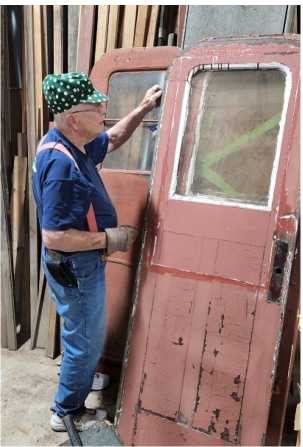
Removed the (4) vestibule doors from the car
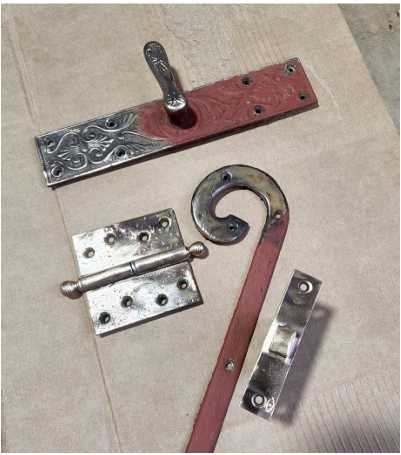
Removed the hardware off of the (4) vestibule doors
Removed the seat cushions from the sleeping compartment and put them into storage
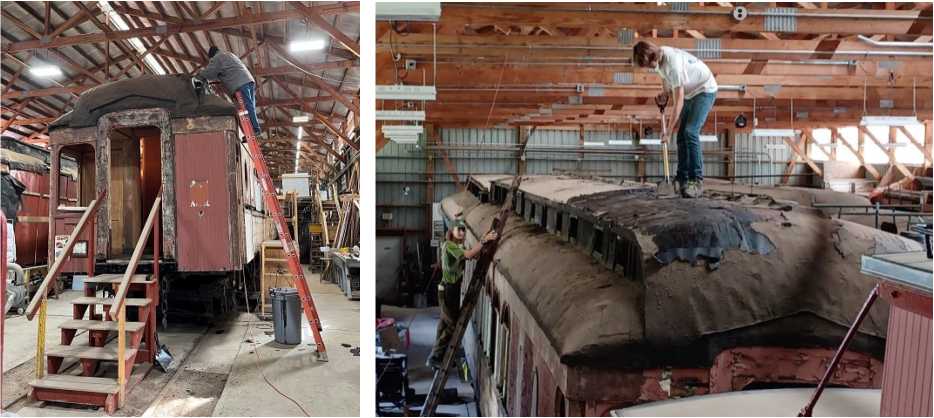
Volunteers removed the old roofing material off of the roof deck and collected samples of the roof drips rails.
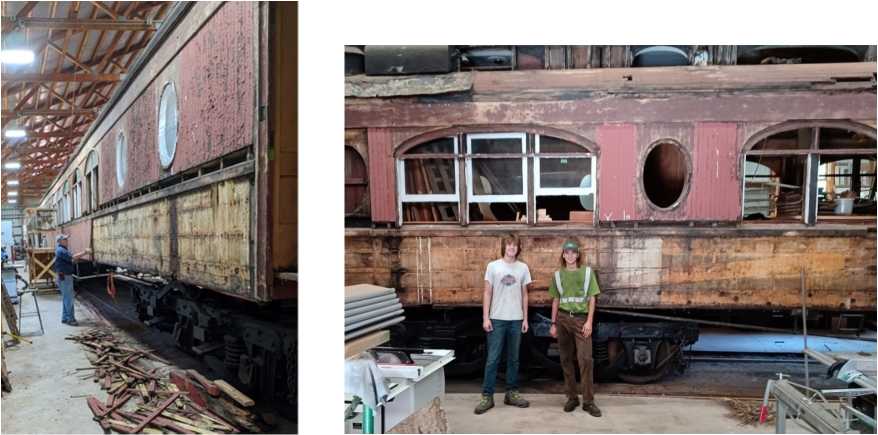
Volunteers removed the original car siding off the car. Exposed is the car framing which is in very good condition.
Volunteers in the process of removing the arched window trim, battens and the intermediate window stops.
Volunteers in the process of removing the arched window trim, battens and the intermediate window stops.
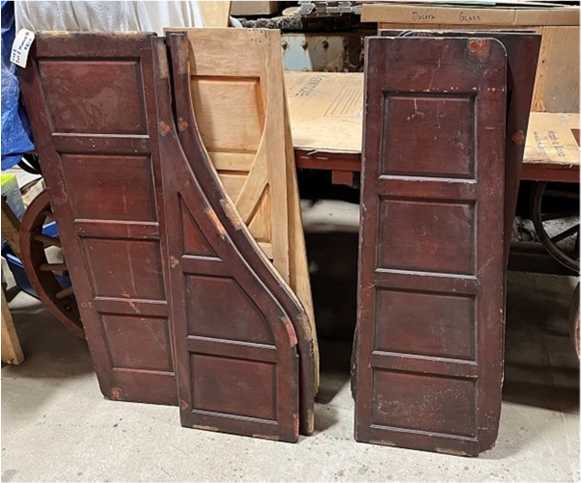
Two of the vestibule doors that were removed for a pattern.
Vestibule door hardware that will be restored.
Stripping
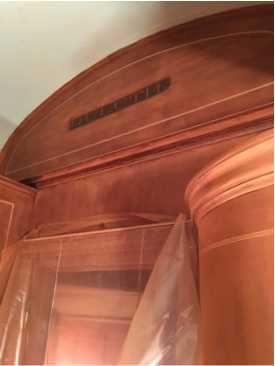
Stripped the old finish off of the end vestibules (interior), Women’s room and north aisle. This completes stripping of all of the old finish off of the entire interior of the car.
Stripped the paint off of the entire letter board
Stripped the paint off of the arched window frames
Stripped the old finish off of the headliner trim pieces
Removed straps and hinges from upper berth racks
Stripped the old finish off of the upper berth racks
Removed all of the inner window frames (25) and sent them out for stripping
Sent out the berth headboards for stripping
Sanded the lower sides of the car (exterior) to remove the old glue off of the wood framing
A view of the aisle, on the north end of the car. This area was stripped of its old finish in 2022.
The transom panel above the north door. This area was stripped of its old finish in 2022.
The letter board in the process of being stripped and sanded.
The letter board in the process of being stripped and sanded.
The removable berth headboards staged for delivery to the firm that will strip and refinish them.
Restoration Work
Installation and Painting
Repaired (7) of the lower roof carlines
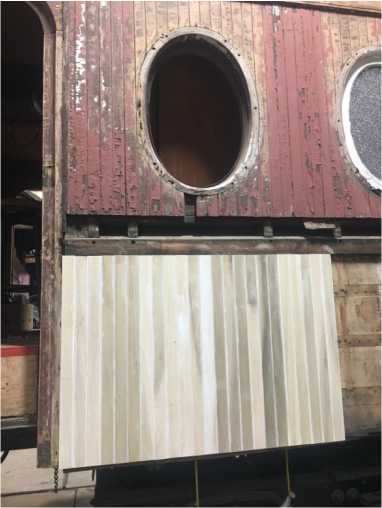
Cut, fit and glued new car siding on the west side of the car (north end). The section of siding consisted of approximately four feet of the car side.
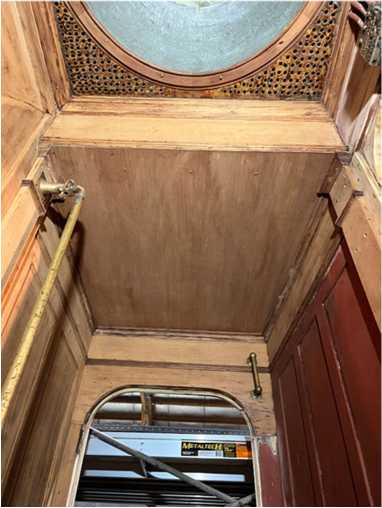
Installed a new vestibule ceiling panel in the SE corner of the car
Cleaned, primer and painted the iron work (truss rods, queen posts, etc.) under the car
New siding that was applied to DULUTH.
A new ceiling panel installed in the vestibule.
Materials
Ordered replacement specialty wood parts for (window trim, veneer panel, etc.)
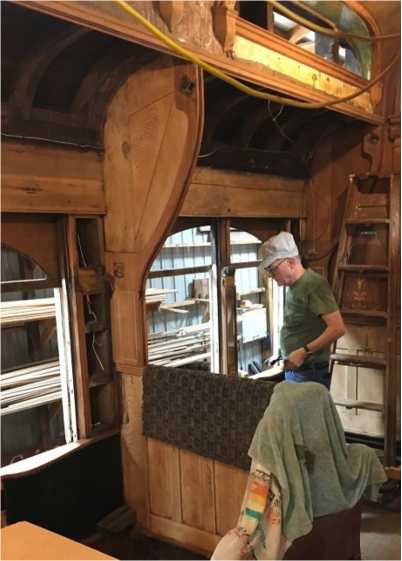
Test fit the berth divider trim piece in the sleeping compartment
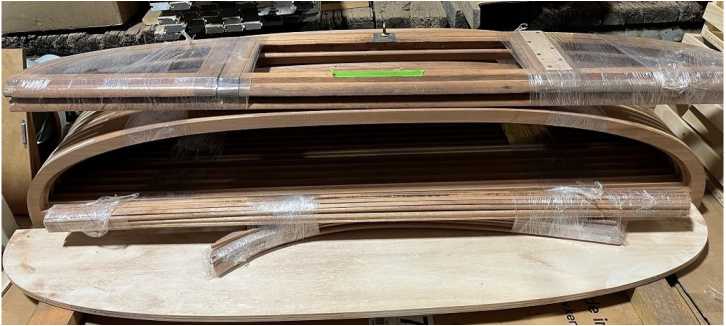
Received specialty wood parts made including the clearstory window frames, trim, battens, veneer panels, berth divider trim pieces, etc.
Sent out a vestibule door and other wood samples to woodworking shop for replicating the new parts (2023 delivery).
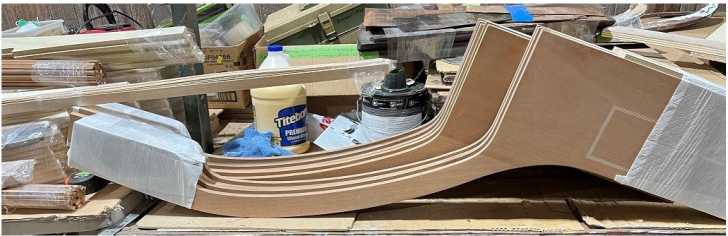
Purchased poplar material for the upper and lower drip rails
Milled the new upper (inner) and lower drip rail stock
One of the volunteers test fitting the berth partition trim piece.
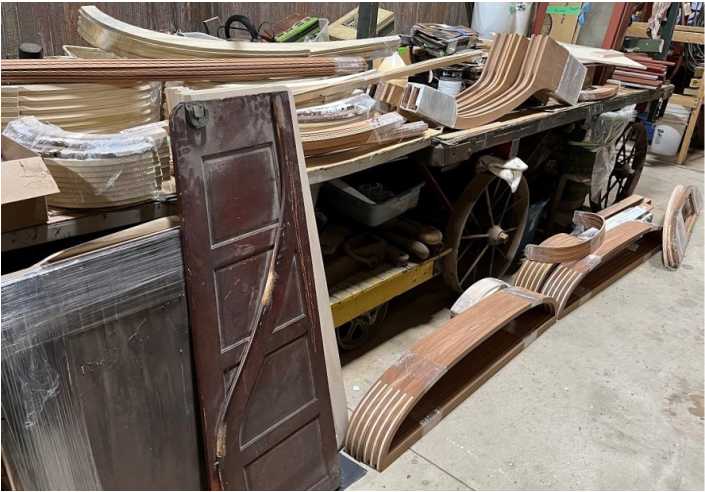
Sample parts from the DULUTH (to the left) and new custom made wood parts made for the DULUTH. Parts include clerestory windows, berth partition trim pieces, window battens and window post trim.
Custom-made interior trim pieces complete with marquetry to match the original design.
A complete set of custom made clerestory windows made for the DULUTH. Once complete these frames will be fitted with stained glass.
New lower roof drip rail (L) based on a sample piece (R) acquired from the car. Volunteers milled the trip rail set at the Fox Valley Technical College.
Parts and Hardware
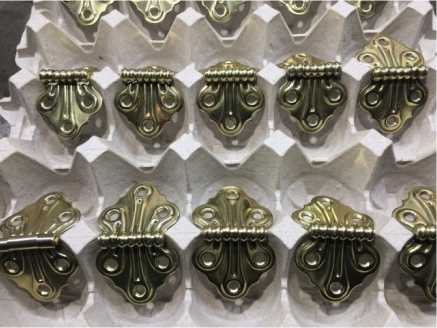
Cleaned and polished brass hardware for the sleeping compartment of the car. Presently 99% of the berth and sleeping compartment hardware has been obtained, reconditioned and restored.
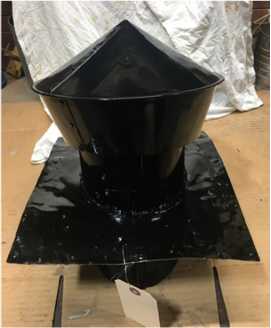
Restored (4) toilet room roof vents for the DULUTH
Fabricated a new stack cover for the Baker heater
Restored and polished the (20) berth dampers
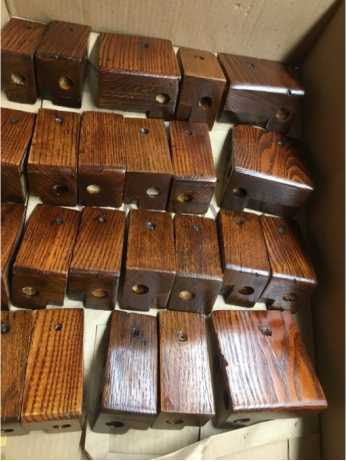
Stained and varnished the wood plunger blocks for the berths
Fabricated (6) new steel berth cushion support straps
Made replica berth curtain rod end supports (12) and curtain rods (6)
Restored the berth ladder for the car
Cleaned and polished coach lamps and associated parts (in process)
Acquired one of the overhead entryway oil lamps for the car
Stripped the paint off of the vestibule door hardware
Stripped the brass window catches (100) needed for the car
Sent out the wooden berth racks (10) and the (8) headboards for finishing (in process)
A sampling of the brass window and interior hardware that was cleaned and polished during the year.
The brass headboard hinges that were cleaned and polished.
An original toilet room roof vent that was restored.
Cleaned and polished brass parts for oil coach lamps.
Wood blocks restored for the upper berth dampers.
Wiring
For safety and reliability purposes the entire car is being rewired. This includes the wiring for all of the interior car lighting as well as the low voltage annunciator system.
Removed wall trim around the berth lights to access the wiring
Removed all of the existing wiring in the sleeping compartment
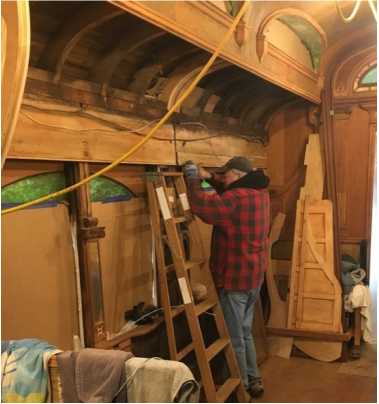
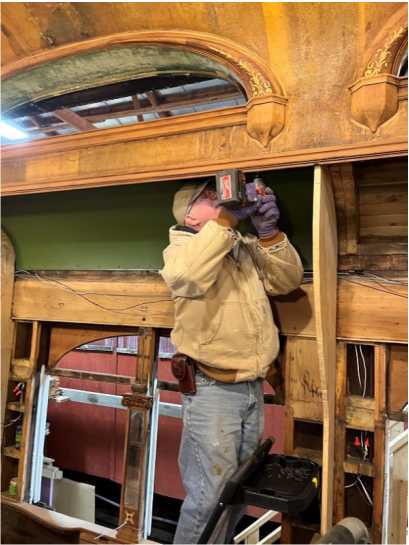
Installed new wiring for the sleeping compartment berth lamps (Qty. 20). (In process)
Installed new wiring for the sleeping compartment annunciator buttons (in process)
Volunteer installing new wiring for the berth lights in the sleeping compartment.
Volunteer installing the new wiring for the sleeping compartment annunciator buttons.
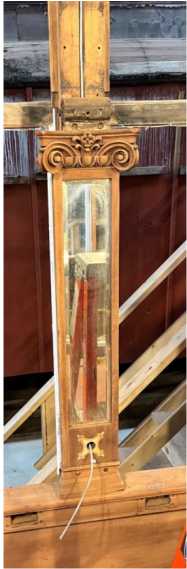
Sleeping compartment annunciator buttons.
Stained Glass
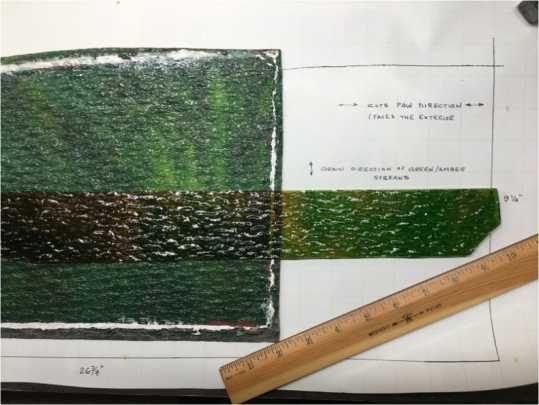
New stained glass material (sheets) from Kokomo Glass were received for the lower arched and oval windows
Took receipt of the new stained glass that was cut to size for the lower arched windows
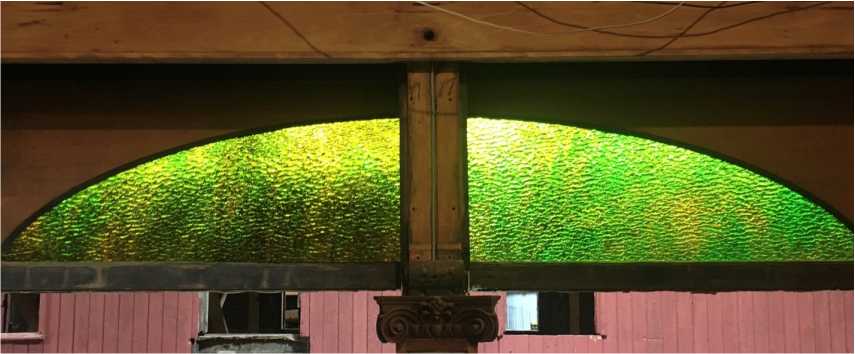
Temporarily fit two new pieces of stained glass in the arched window frames
Provided the stained glass shop with oval window frames so the new stained glass can be made to fit into the oval windows (2023 delivery)
A piece of the old stained glass (the large piece) with a sample of the new stained glass (small piece).
A view of the new stained glass installed in the sleeping compartment of the DULUTH.
Headliners
Cut the plywood to size for the headliners
Cut the canvas to size and glued the canvas to the sleeping compartment headliners
Painted the only remaining (original) headliner (#10) in the sleeping compartment
Painted the new headliner panels (#1-9). (in process)
Installed the headliner panels in the car. (in process 4 of 9 installed)
The new headlining panel being installed in the car.
One of the completed headlining panels installed in the sleeping compartment.
Fundraising
$29,650.65 in donations were received in 2022. The largest donation came from the Emery Rail Heritage Trust grant ($15,000).
The “Giving Tuesday Fundraising Challenge” was met by successfully matching the $1200 challenge, in turn raising a total of $2400 for the DULUTH project.
Expenses
Contract work
$25,937.62
Labor
$6,945.83
Supplies
$2,456.00
Freight
$187.34
Total Expenses for 2022
$35, 526.79
Volunteers
In 2022 over (20) MCRM volunteers logged (555) man hours of time on the DULUTH project.
Publicity and Events
A film crew from TRAINS magazine was on hand in the Duluth to perform a Trains LIVE video production. The crew filmed inside and outside the car while commentator Bob Lettenberger discussed the history of the car and the restoration process.
The DULUTH was opened up for tours in MCRM’s Car Shop during MCRM’s annual Vintage Rail Car Tours.
The DULUTH project was featured in the September 26th edition of the Baraboo Newspaper.
The Trains Magazine crew video taping inside the DULUTH.
Mid-Continent Railway MuseumPosted on by Jeffrey Lentz
Read to the end to see how you can volunteer to help bring 1385 back to operation!
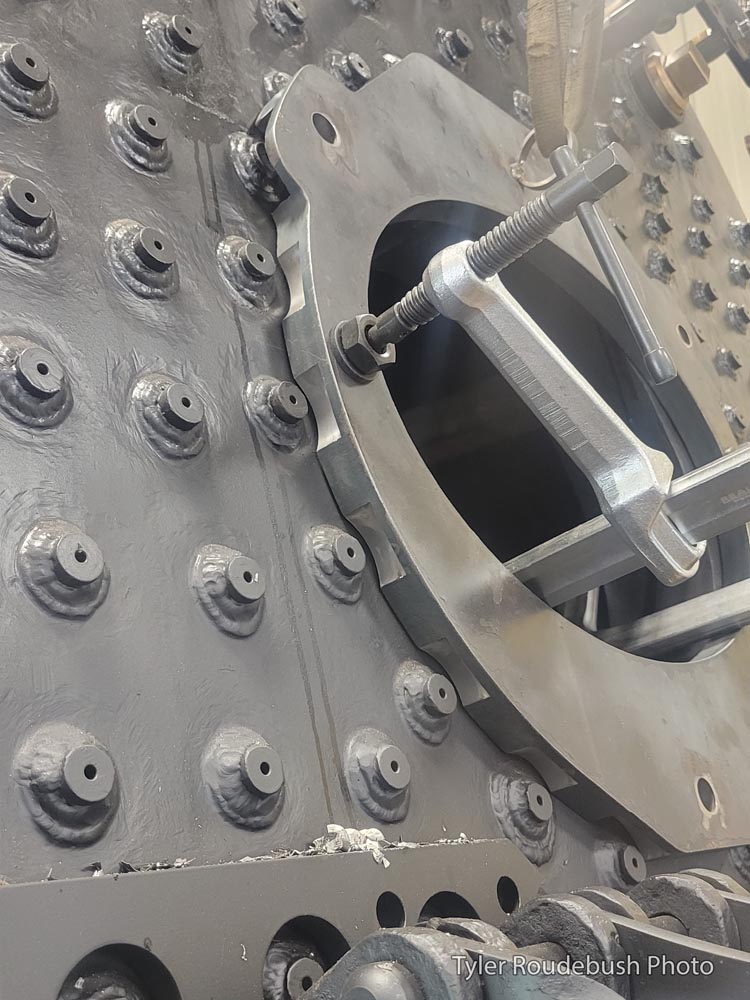
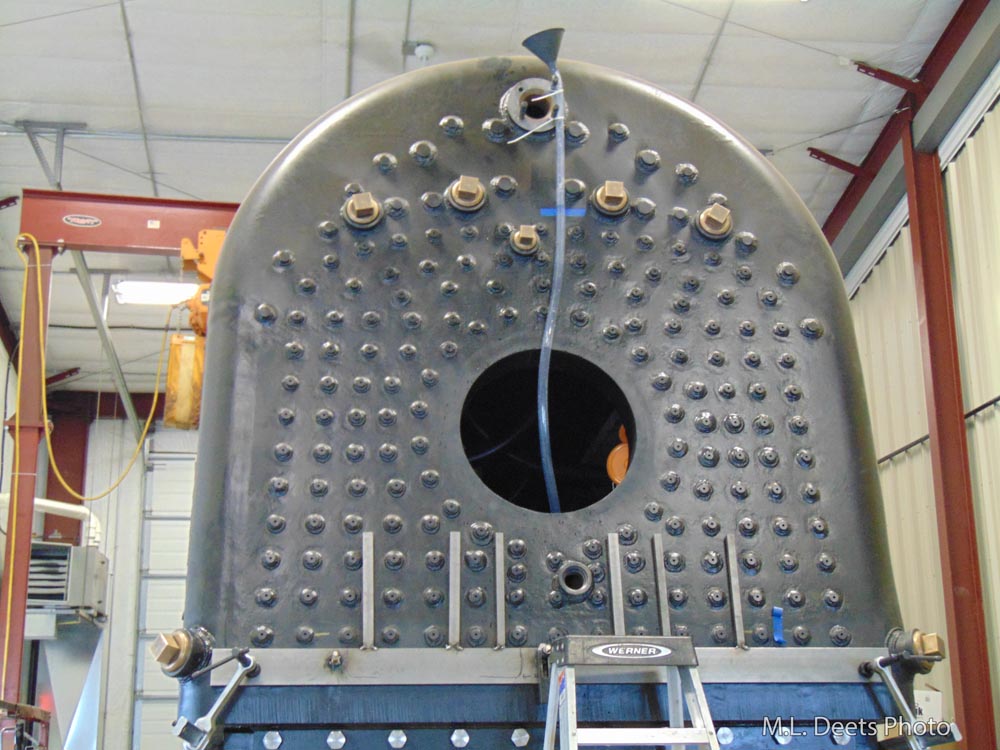
The next fixture to be mounted on the backhead of 1385’s boiler is the firedoor – the fireman’s target. The Franklin air-operated Butterfly door had been completely rebuilt and was patiently waiting its turn to rejoin the 1385. Like other appurtenances mounted on the boiler the firedoor will have to utilize a spacer ring to allow for the height of the staybolt heads that stand proud of the boiler surface. As noted in earlier updates current construction codes require that the head of the staybolt stand above any weld.
The first step in the process is a simple cardboard and paper template is set on the backhead to mark the position of each of the staybolts. The template for the adapter ring is an outline of the door mounting ring.
Paper and cardboard are used to create a mockup.
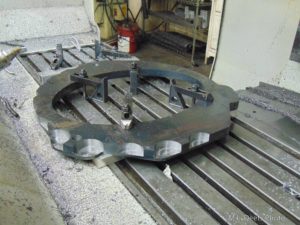
After the adapter ring has been cut out of a plate of steel it is set up on the bed of a CNC milling machine and the clearance notches for the staybolt heads are cut so the adapter and the door can lay flat on the boiler.
Machining the firedoor adapter.
The adapter is then positioned and clamped to the backhead so the holes for the mounting studs can be drilled and tapped.
Fitting the adapter to the backhead.
Detail of staybolt clearance notches.
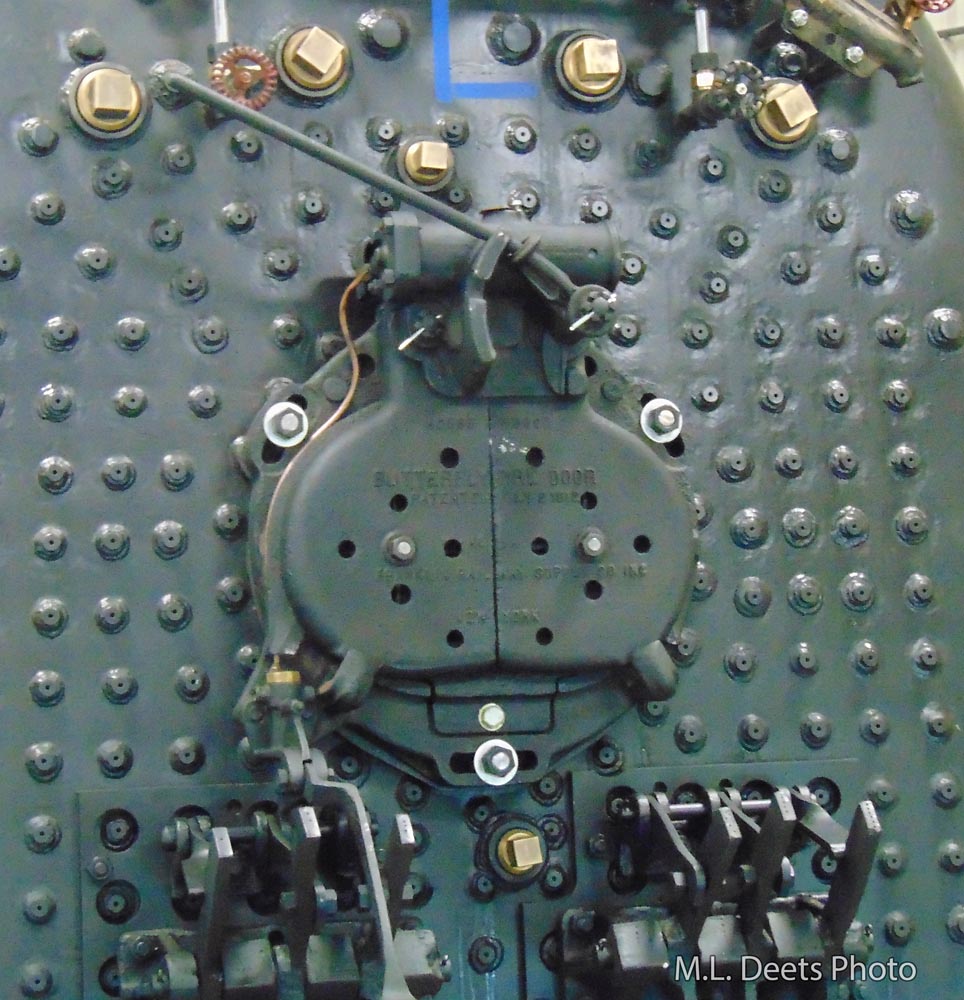
Once the drilling and tapping is finished the rebuilt door is mounted.
Firedoor mounted.
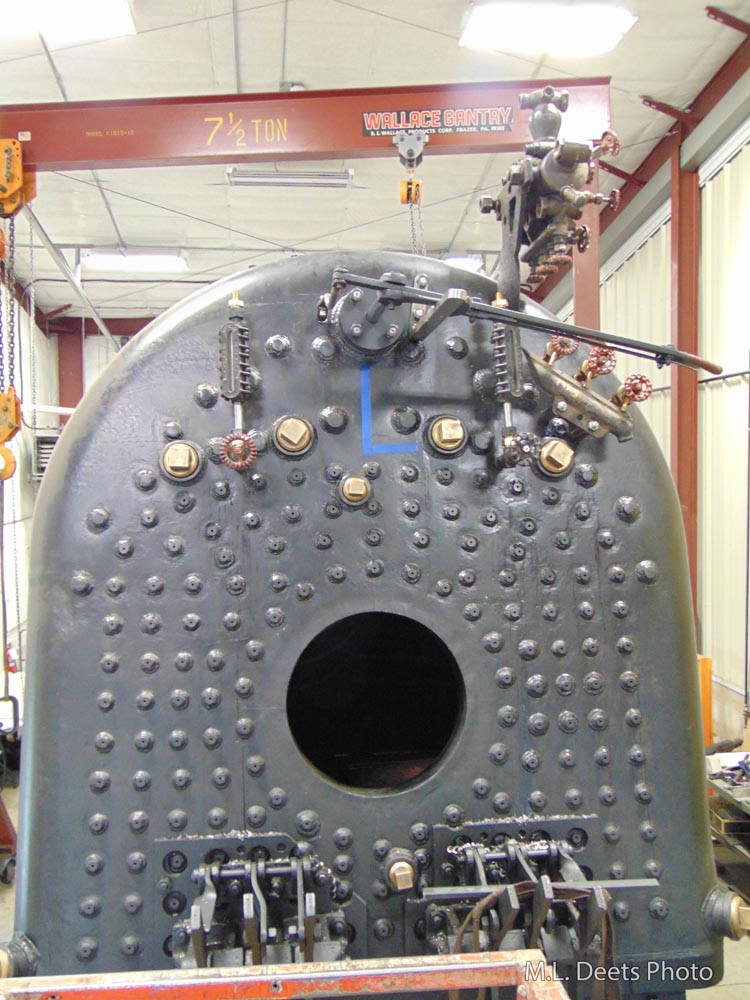
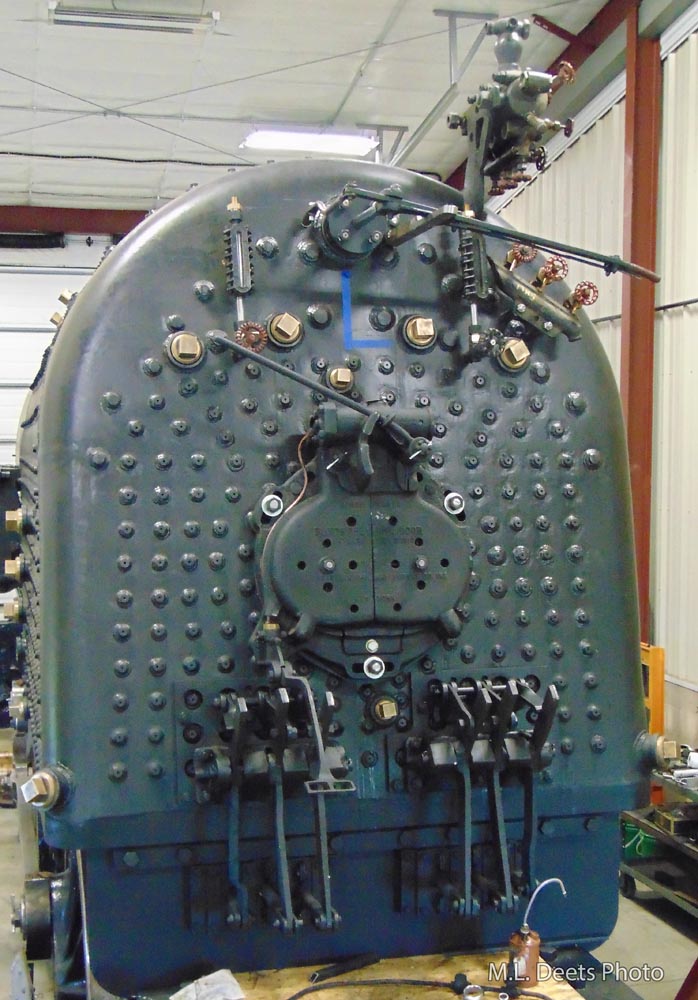
Here is a before and after comparison.
Before firedoor installation.After firedoor installation.
As an added bonus here is a short video clip of the door in action in its new home.
For extra credit here is a comparison of the backhead between the start of 2022 and late 2022. Installation visible included the lubricator, throttle, try-cocks, sight glasses, grates and grate shaker mechanism, and firedoor.
C&NW #1385 Volunteer Opportunity
Calling All Volunteers:
Who: YOU! What: Painting Party for parts of the 1385 Where: Middleton, WI When: Friday & Saturday February 24 & 25, 2023 Why: To help complete the Rebuild and Reconnect with the Engine
It has been far too long since we’ve had a 1385 Volunteer Session at SPEC Machine and we are going to cure that with a painting party! We will be painting many loose parts for the engine such as the ashpan, brackets for the air tanks, bracket for the power reverse, sand dome parts and many others. This is a Friday and Saturday session to allow business owner Steve at least a one day weekend.
We plan to start about 9 AM both days and knock off around 4 – 5 PM whenever a good stopping point is reached.
There will be a big pot ‘o chili for lunch and folks are encouraged to bring along something to share. Potluck is always such fun.
If you can make it one day or both please either sign up on our volunteering form (use button below) or previous volunteers can contact Pete Deets directly. RSVP is required so that enough chili can be cooked up.
Any time given will be thankfully accepted greatly appreciated.
**UPDATE** Due to insurance requirements related to this volunteer session being held at a contractor’s facility, this volunteer session will only be open to members of Mid-Continent Railway Historical Society. To learn more about becoming a member and the perks that come with membership, visit the Join Us page.
Mid-Continent Railway MuseumPosted on by Jeffrey Lentz
Join the Mid-Continent Railway Operating Crew
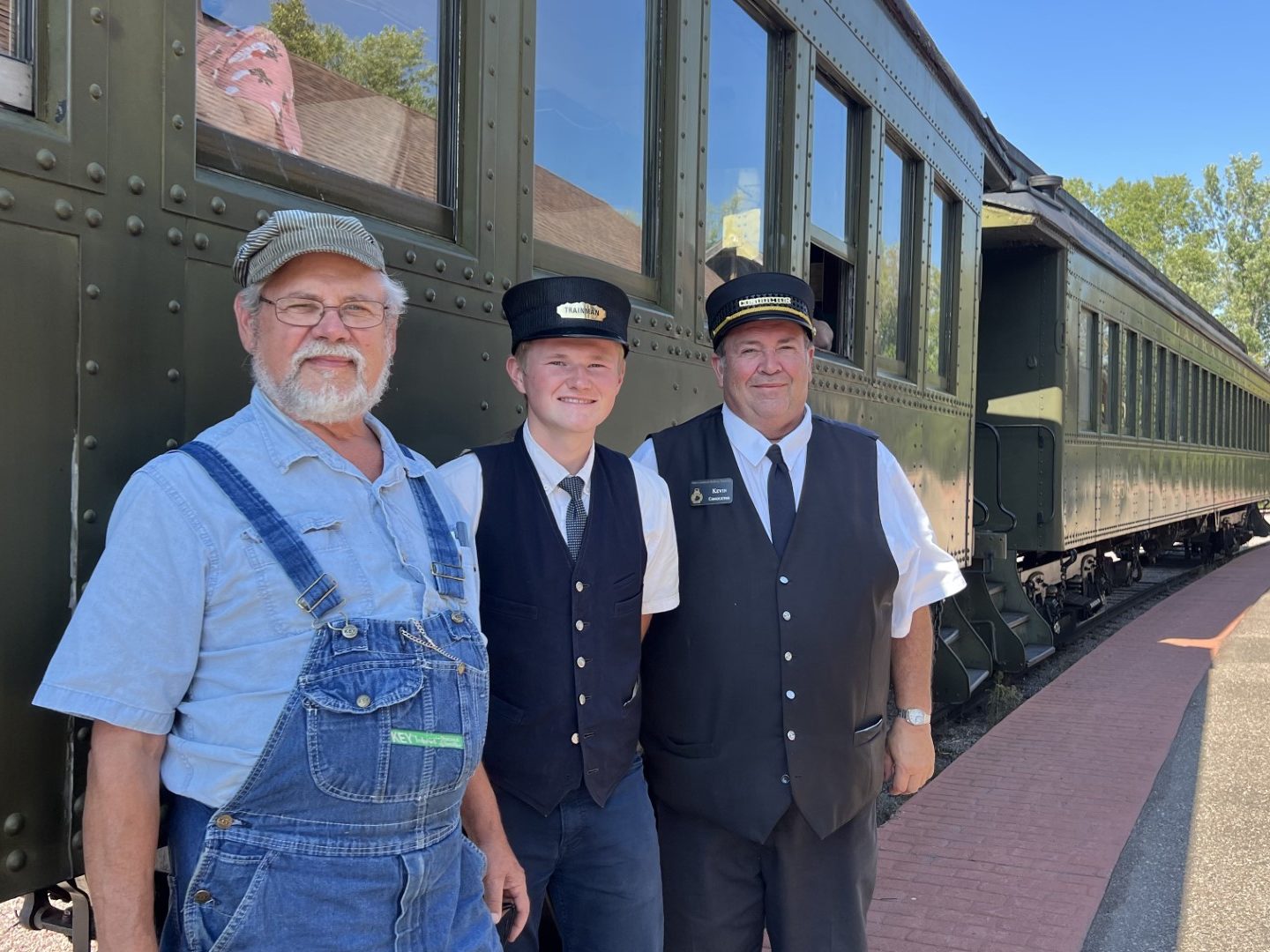
Here is a unique opportunity to be a part of our working railroad by joining the Mid-Continent Railway Museum Operating Department. We are now accepting applications for our trainman class which starts on April 22nd, 2023.
Join Mid-Continent’s operating crews
What does a trainman do?
Note: The term ‘trainman’ is the historical job title used by railroads of the era and thus is used at Mid-Continent. Women can and do serve as trainmen as well and are encouraged to participate in all facets of museum operations.
Trainmen work alongside the conductor, fireman, and engineer to operate demonstration train rides for museum visitors. The position includes physical aspects: coupling/uncoupling cars, guiding train movements, inspecting cars, etc. It also includes social aspects: speaking with museum visitors and passengers, answering questions, and serving as a public face of the museum.
What is taught in the trainman class?
During your four-day training (two weekends) you’ll learn the basic operating and safety rules in use by Mid-Continent Railway during classroom sessions and then working outside with the museum’s equipment during the hands-on portion.
Eligibility requirements
Only Mid-Continent Railway Museum members ages 18 and above and in good standing are eligible (Learn about becoming a member). Four days of in-classroom and on-site training is required followed by individually scheduled days of job shadowing and a final qualifying test. Persons qualified on other railroads are not exempted from the required training. Limited class space is available and signup is offered on a first-come, first-serve basis.
Keep in mind that some aspects will require you to be physically capable of – but not limited to – performing such tasks as throwing switches, replacing coupler knuckles, minor rolling stock maintenance, climbing onto and off of equipment, and working in all types of weather conditions.
Do I have to know a great deal about trains and railroad history to enroll?
What you need to know about train operations will be taught to you in class. As for general railroad and railroad history knowledge, there are no prerequisites or tests. You will learn a lot just by going through the class and student trips as well as being around fellow volunteers. Your instructors may have suggested reading materials for you as well.
How frequently is the trainman class offered?
The trainman class is offered once per year, each spring.
Is there a class to become a conductor or locomotive engineer?
Yes, but all new train crew volunteers are required to first start as a trainman.
How much does the trainman class cost?
The cost to attend is free, but you will need to equip yourself with the proper clothing and purchase a rule book which will be explained in the trainee’s invitation email.
What is the time commitment?
The training program lasts four days (April 22nd-23rd and May 13th-14th, 8 AM-5 PM each day). This must be followed up by completing three-to-four days of student trips prior to the end of the operating season. Student trips are done on your schedule and can be completed during most any day that trains are operating.
In subsequent years, volunteers are expected to volunteer in train crew service a minimum of four days each year to remain qualified. Every third year train crew members must also attend a one-day refresher and recertification test.
What if I am not a Mid-Continent Railway Museum member?
Museum membership is open to anyone and starts at $40.00 per year. For more information on membership, see the Join Us page.
How do I sign up for the trainman class or find out more information?
Simply contact the Mid-Continent Railway Museum office at 608-522-4261 or inquiries@midcontinent.org to verify your museum membership status (or help you sign up to become a new member). Office staff will then put in contact with MCRM’s Operating Department training officer.
Is this class only for volunteers, or are there paid positions available?
Most of Mid-Continent’s crews are volunteers, but Mid-Continent does hire a few seasonal positions train crew positions to supplement our volunteers. Hired crews work 5-days/week Tues-Sat, mid- June through early September. If you are potentially interested in joining the Operating Department as an employee, please let our office staff know when contacting them.
Mid-Continent Railway MuseumPosted on by Jeffrey Lentz
This is an older update that was delayed getting posted online. Thank you for your patience. — The Webmaster
Adding Cistern Piping
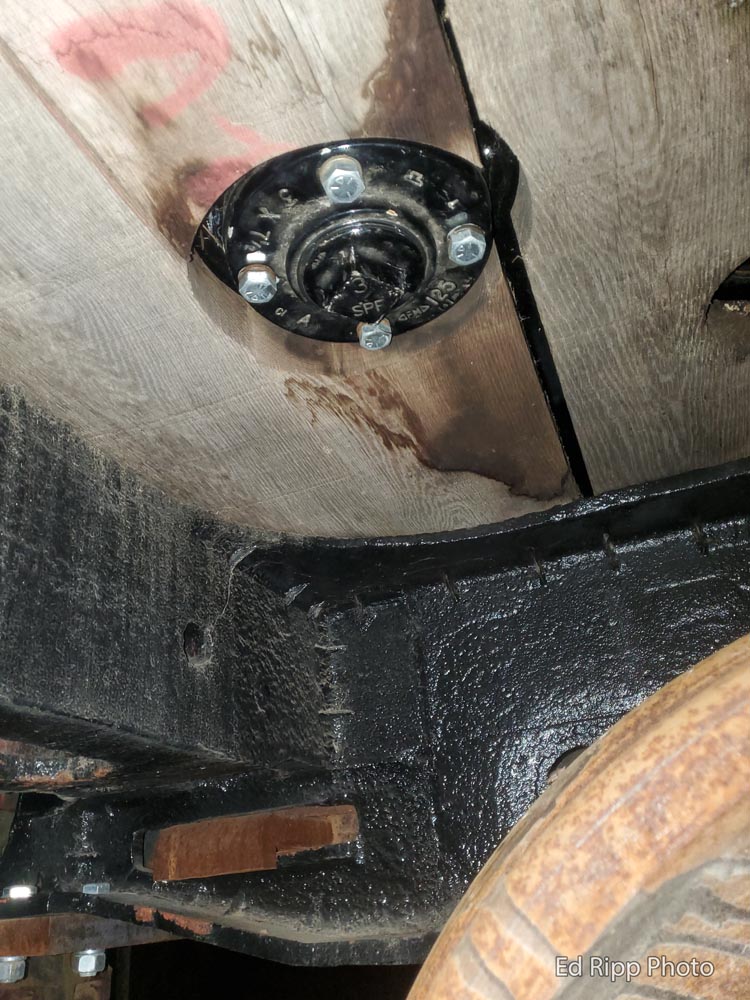
In October, volunteers continued working on Chicago & North Western #1385’s tender cistern ports. This included installing bottom fill piping and ports for connecting to a canteen car, otherwise known as an auxiliary tender.
Bottom fill exterior piping.
Bottom fill pipe outlet installed.
Cistern port.
On Mid-Continent’s shortline railway, 1385’s tender has more than enough water capacity to keep 1385 steaming, but a canteen car becomes more important when water sources are harder to come by. Mid-Continent’s canteen car, which offers an additional 12,000 gallons of water capacity, was frequently found trailing 1385’s tender when the locomotive was venturing around the Upper Midwest on mainline excursions. Mid-Continent’s canteen car is currently on display near the museum’s water tower.
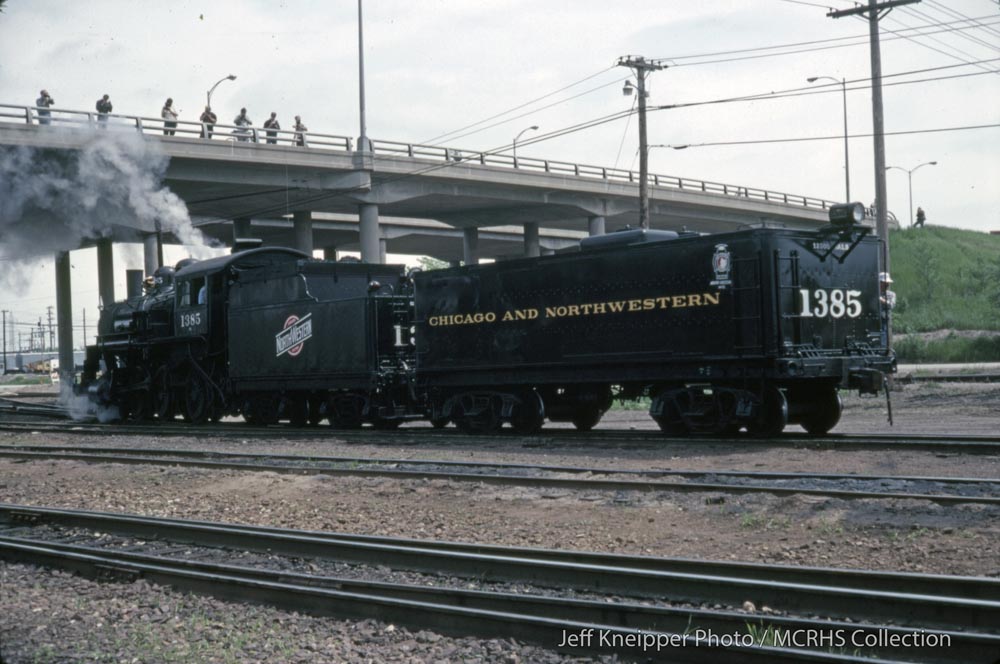
C&NW 1385 with canteen car at Butler, Wis. for “Butler Railroad Days” event on June 5, 1983. Jeff Kneipper photo. MCRHS Collection.
Test Filling the Tender
On October 29th, a team of volunteers including Pete Deets, Kyle Gerke, Richard Gruber, and Ed Ripp filled 1385’s tender with water up to its maximum capacity. This was done for testing purposes.
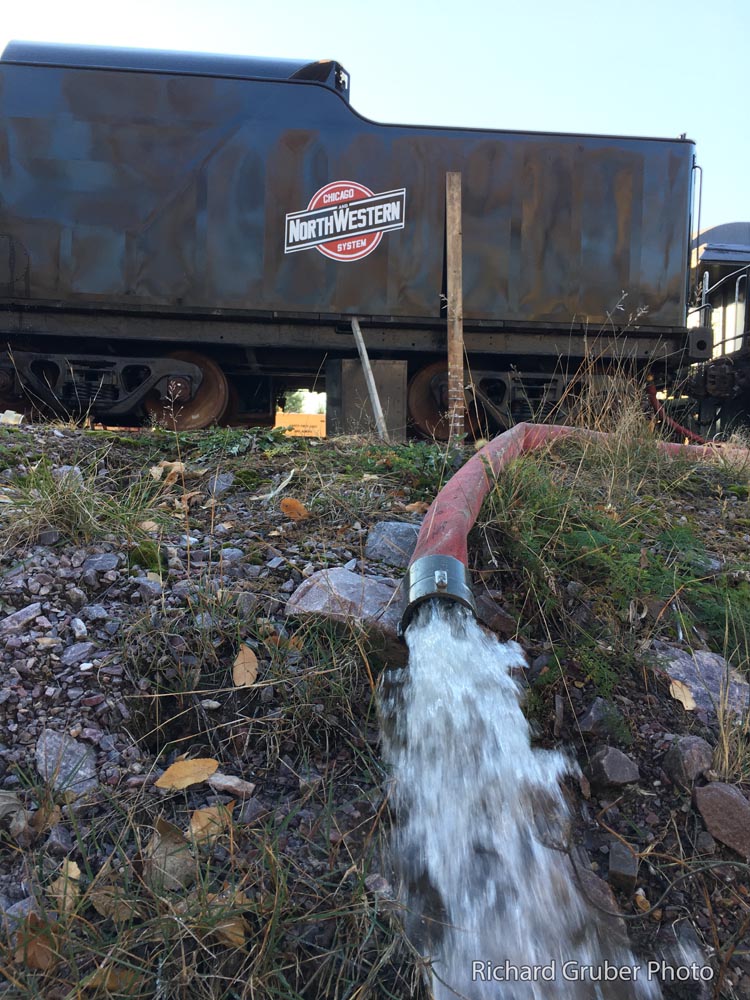
Although the Mid-Continent’s Engine House has a faucet connected to the museum’s groundwater well, that system lacks sufficient capacity to fill a tender in a timely fashion. For a quicker fill time, volunteers utilized a submersible pump that had last been used when steam was in regular service, and pumped the water directly out of the adjacent Baraboo River using a 2-inch hose. The river water contains many impurities and will not be used when running steam in the future, but for doing a test fill of the tender, Baraboo River water would work just fine.
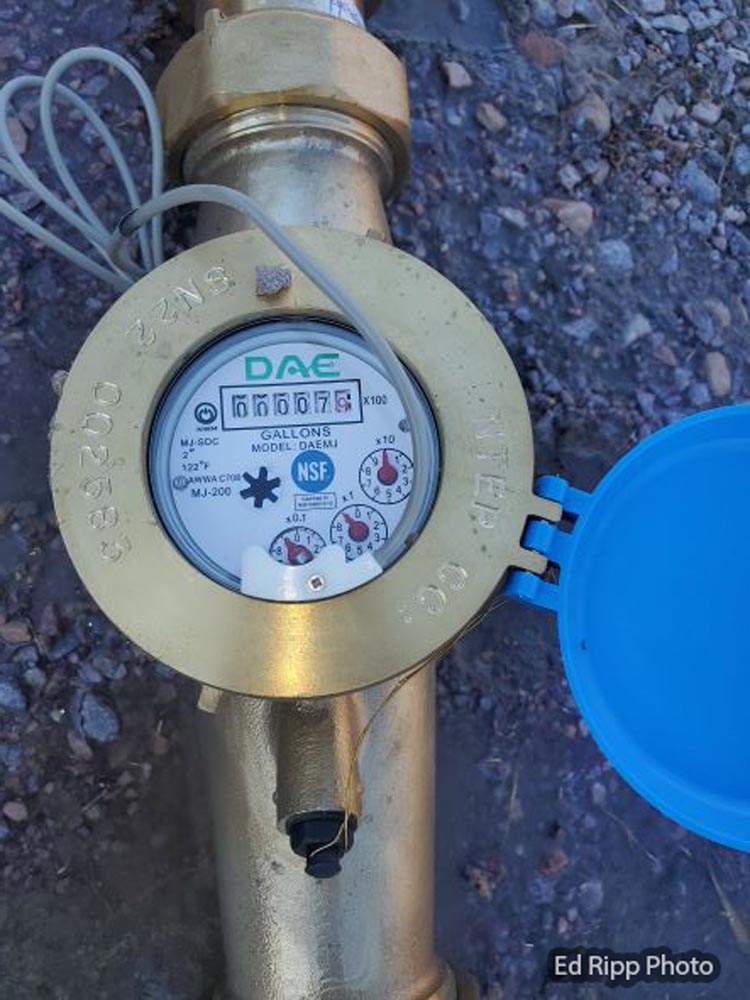
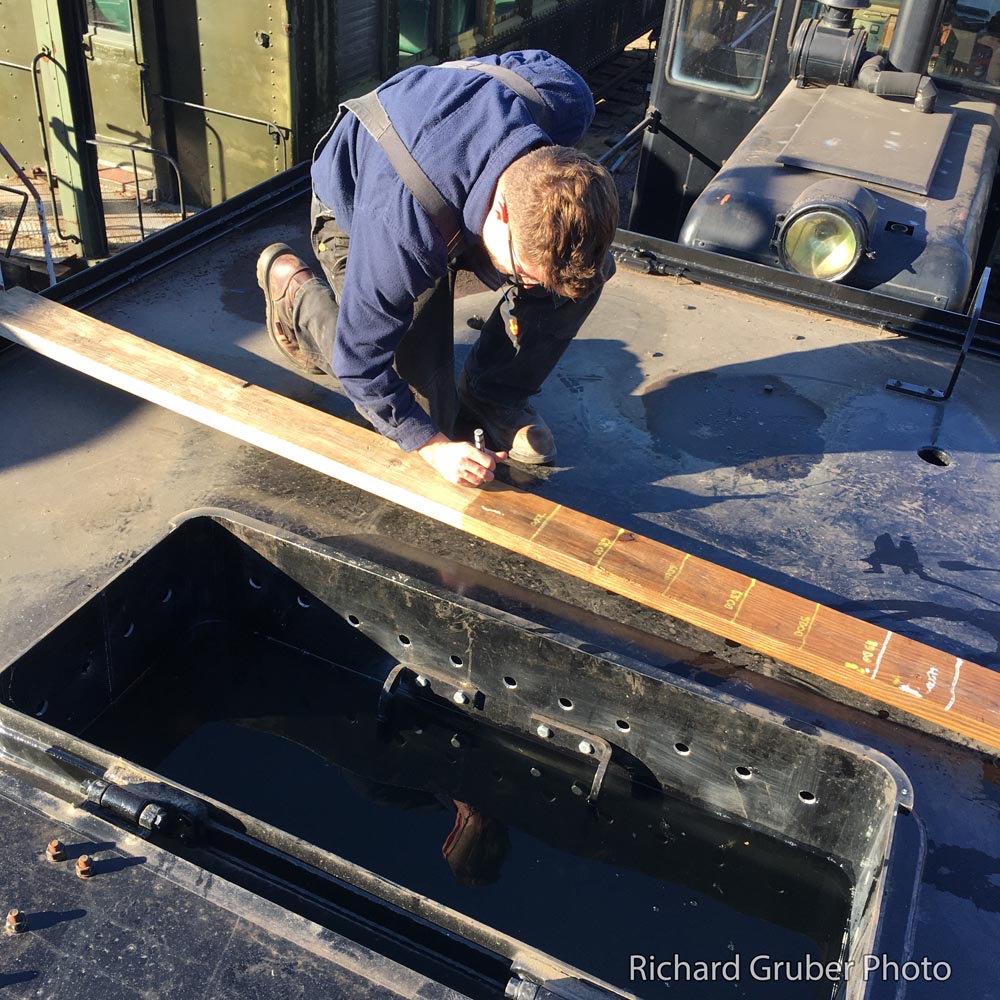
Attached to the hose was a water meter to allow an accurate measurement of the gallons pumped into the tender. While filling the tank, one person watched the water meter and another person was on top of the tender marking a board with measurement lines. This was necessary because 1385’s tender has a new cistern. These measurements will be transcribed to a water level meter used by engine crews in the future.
Water meter
Kyle, kneeling atop the tender, adds water measurement markings to a measuring board.
Draining the tender at the end of testing.
Measurements were also taken of the drawbar pocket and the center of the rear coupler when the tender was empty and again when full. Marks were also made on each truck at the bolster and pedestal jaw at empty, half-full, and full to see how much the springs settled with the differing weights.
During this testing, some additional to-do items were discovered and added to the work list.
Upcoming Work
Volunteers kept busy preparing for and hosting Santa Express in November and December no additional work sessions on the 1385’s tender were held in 2022, but in December the tender was moved inside the Engine House to permit work to continue during the winter months. The first winter work session inside the Engine House is tentatively scheduled for January 7th and 8th. Volunteers may also be working on Western Coal & Coke #1 and performing some general shop cleanup/organization work.
Persons interested in volunteering for this or future volunteer sessions should contact Ed Ripp, General Foreman of Steam Power, or fill out the volunteering inquiry form.
Contains information related to marketing campaigns of the user. These are shared with Google AdWords / Google Ads when the Google Ads and Google Analytics accounts are linked together.
90 days
__utma
ID used to identify users and sessions
2 years after last activity
__utmt
Used to monitor number of Google Analytics server requests
10 minutes
__utmb
Used to distinguish new sessions and visits. This cookie is set when the GA.js javascript library is loaded and there is no existing __utmb cookie. The cookie is updated every time data is sent to the Google Analytics server.
30 minutes after last activity
__utmc
Used only with old Urchin versions of Google Analytics and not with GA.js. Was used to distinguish between new sessions and visits at the end of a session.
End of session (browser)
__utmz
Contains information about the traffic source or campaign that directed user to the website. The cookie is set when the GA.js javascript is loaded and updated when data is sent to the Google Anaytics server
6 months after last activity
__utmv
Contains custom information set by the web developer via the _setCustomVar method in Google Analytics. This cookie is updated every time new data is sent to the Google Analytics server.
2 years after last activity
__utmx
Used to determine whether a user is included in an A / B or Multivariate test.
18 months
_ga
ID used to identify users
2 years
_gali
Used by Google Analytics to determine which links on a page are being clicked
30 seconds
_ga_
ID used to identify users
2 years
_gid
ID used to identify users for 24 hours after last activity
24 hours
_gat
Used to monitor number of Google Analytics server requests when using Google Tag Manager